


The founding story of Zapply
I went against the men's health industry.
Today, 200,000 men
take what I built.
I'm Jelte, co-founder of Zapply. This is what nutrition school never taught me, the road I watched men take instead, and the formula I built because of it.
By Jelte Slump

What they never taught us
I graduated as a nutritionist knowing how the body uses food, how a deficiency shows up, and how to build a plan around a person.
There was one thing nobody had taught us. I found it a few months later, at my kitchen table at one in the morning, reading a study I'd gone looking for after a client asked me a question I couldn't answer.
Men's testosterone has been dropping for decades.
Generation after generation, all over the world.

That study followed 1,532 men in Massachusetts. Their testosterone fell by about 1.2% a year between 1987 and 2004, on top of the drop that comes with age. A 50 year-old in the later years had lower testosterone than a 50-year-old had in the late 1980s¹. A Danish study of 5,350 men found the same pattern².
1.2%
a year. The fall in men's testosterone from 1987 to 2004, beyond normal aging¹
5,350
Danish men in a second study that found the same pattern²
I read both twice. Then I went back through my lecture notes, looking for any mention of it. There wasn't one.
Nobody has proven exactly why this is happening, and the researchers say so themselves. But once I knew about it, I started hearing it everywhere.
The same list, from every man
Clients, friends, guys at my gym. Different ages, different jobs.
The same list:
Energy that's gone by mid-afternoon
Drive that just isn't there anymore
Tired, no matter how long they sleep
Foggy and unfocused
A body that feels like it's slowing down years too early
Most of them had decided it was just getting older. Some had decided they needed something much stronger. That's the part that worried me.

The needle road
I saw men skip the natural road and go straight to testosterone therapy. Needles, often for life.
One of them trained at my gym. He was 38, fit, with two young kids. Between sets he showed me the sign-up page of an online clinic on his phone. He had never had his testosterone tested.
For a man with a real diagnosis, testosterone therapy is proper medicine. But taking testosterone from outside can switch off the body's own production, which is one reason medical guidelines advise against it for men who want children soon⁴.
And many men start without the tests to back it up. A US study found that testosterone use among men over 40 more than tripled between 2001 and 2011. A quarter of the men starting it had no testosterone test in the year before, and only half had a diagnosis of low testosterone³. Guidelines say to diagnose only when a man has symptoms and repeatedly low lab results⁴.

3×
more men over 40 on testosterone therapy in 2011 than in 2001³
1 in 4
started with no testosterone test in the year before³
1 in 2
had a diagnosis of low testosterone³
I'm not his doctor, and I didn't tell him what to do. I asked him one question: when did you last check your zinc, magnesium and vitamin D?
He laughed. Never.
Most of them were just running low
Here's what I believed then, and still believe now. Before needles, there's a simpler question. A lot of these men were running low on the minerals and vitamins that keep testosterone where it should be: zinc, selenium, magnesium, vitamin D.
Zinc is the clearest example. In a controlled study, young men put on a low-zinc diet for 20 weeks saw their testosterone fall from about 1,150 to about 305 ng/dL. Older men who were mildly short of zinc, and took it for six months, went from about 240 to about 460⁵.
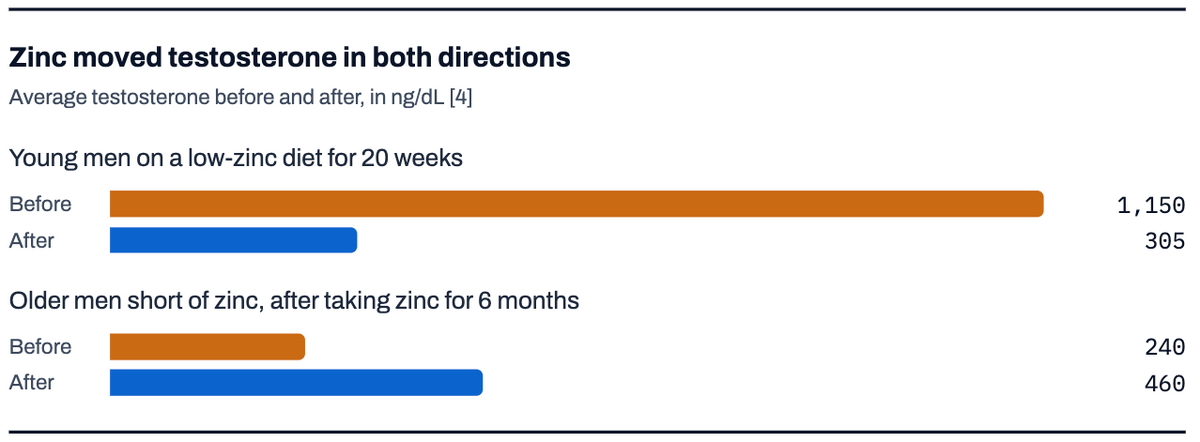
Read that properly, because it cuts both ways. Zinc helped the men who were short of it. If you already get enough, more won't push you higher.
And being short is common. CDC survey data put about one in four Americans at risk of inadequate vitamin D, and 8% at risk of deficiency⁶.
So the answer I kept coming back to was simple: cover the basics properly, in forms the body can actually use, at real doses.
So I built it
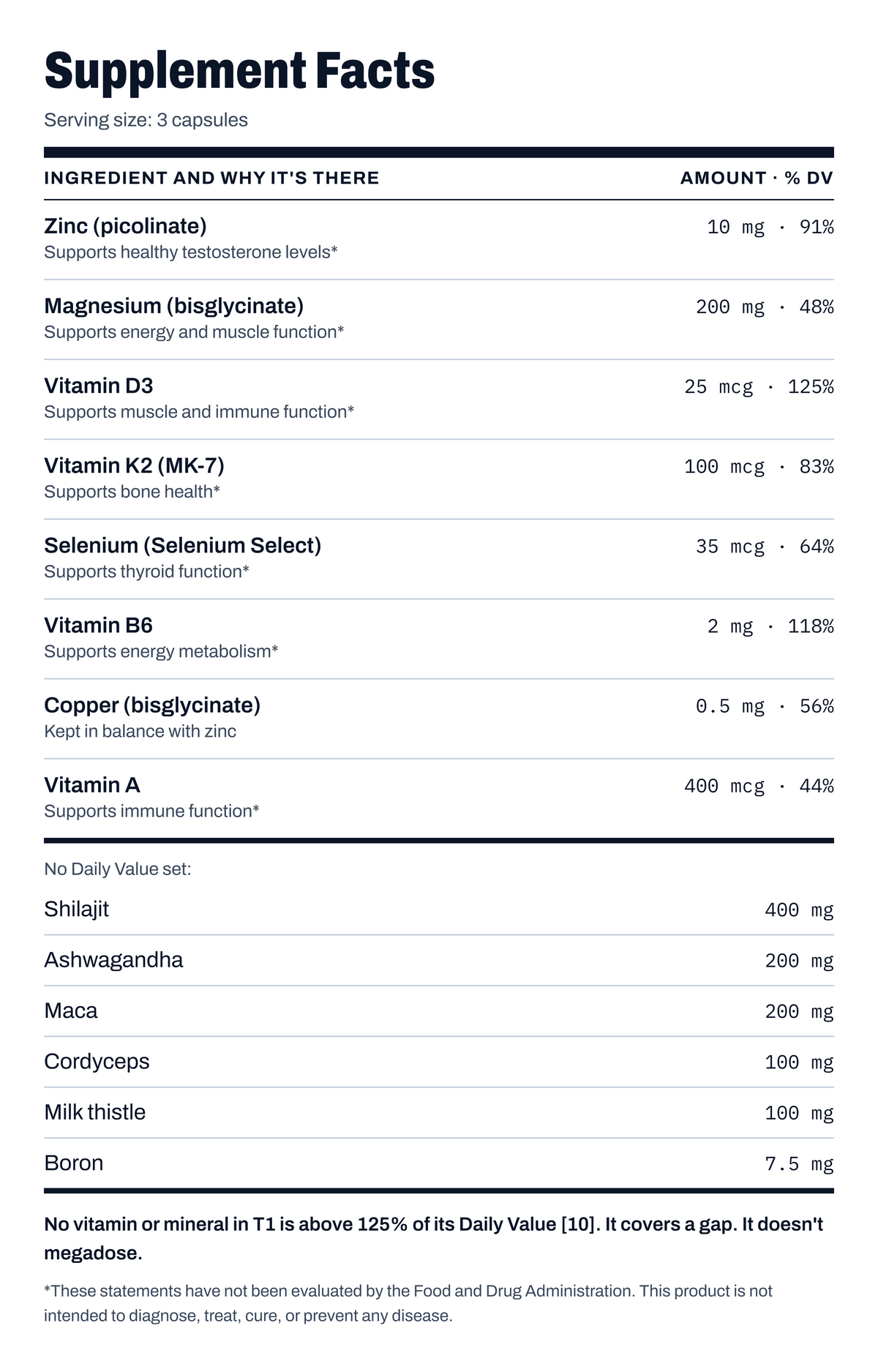
That's why I built Zapply T1. Not another booster, and not ten bottles on the kitchen counter. One daily formula: 14 ingredients in three capsules, taken after your first meal.
WHAT I WOULDN'T PUT IN IT
No proprietary blends. If a brand won't show you the numbers, that's a red flag, not a selling point.
No underdosing. Every ingredient at a real dose, and every dose printed on the label.
No junk fillers.
WHAT I CHOSE INSTEAD
Zinc picolinate, not zinc oxide. Oxide is the cheap form. In one absorption study, three of 15 volunteers absorbed
little or none of it⁷. In a small trial from 1987,
picolinate was the only form that raised zinc levels in the
body⁸. Next to it, a little copper, because high zinc can
push copper down⁹.
Selenium Select. A patented form, and far more expensive than standard selenium.
Vitamin D3 together with K2.
Capsules, not a powder. Nobody wants to dig out a tub and mix a drink every morning.
The first time I priced the formula with Selenium Select in it, my supplier called me back to ask if I'd made a mistake. I hadn't. It raised the cost of every pouch, and I kept it.


Clean enough for athletes who get drug tested
The supplement industry has earned its reputation. In one international study, researchers bought 634 ordinary supplements in 13 countries. 94 of them, or 14.8%, contained steroids that weren't on the label¹¹.
So T1 is held to the standard of men who get drug tested for a living.
Made in the Netherlands, in our own facility. Every ingredient is tested when it comes in, and again when it goes out.
Every batch is third-party tested by Eurofins.
Certified by Informed Sport. The program tests every batch for more than 285 substances banned in sport before it goes on sale, and you can look up your batch number on its website¹².


More than 50 professional athletes take T1, including UFC fighters and boxers. They can't afford to miss a fight because of the wrong supplement.
It works with your life, not instead of it
T1 covers the nutrients. The rest is still on you: real food, decent sleep, moving your body. Put those together, give it a few weeks, and that's the combination I built it for: the energy, focus and drive to feel like yourself again.
WHAT IT WON'T DO
It won't replace medical treatment. If you have a diagnosed testosterone deficiency, follow your doctor.
It isn't a diagnosis. If you've been tired for months, see a doctor and ask for blood work first.
It won't work in a week. Nutrient levels build up over weeks. Judge it at 60 to 90 days.
If you take prescription medication or have a thyroid condition, ask your doctor or pharmacist before you start.
90 days to feel the difference
I'm so confident you'll feel the difference that I'll give you 90 days to get every penny back.
If you're tired, if you've been blaming your age, or if you've got a buddy who still is, this is where I'd start.

Jelte Slump

Try Zapply T1 for
90 days, risk-free
14 ingredients at full dose, every dose on the label
Every batch tested by Informed Sport and Eurofins
90-day money-back guarantee
Not sure it's right for you? Read "What T1 won't do" first.
- Travison et al.A population-level decline in serum testosterone levels in American men. J Clin Endocrinol Metab, 2007.
- Andersson et al.Secular decline in male testosterone and sex hormone binding globulin serum levels in Danish population surveys. J Clin Endocrinol Metab, 2007.
- Baillargeon et al.Trends in androgen prescribing in the United States, 2001 to 2011. JAMA Intern Med, 2013.
- Endocrine Society.Testosterone Therapy in Men With Hypogonadism: clinical practice guideline. 2018.
- Prasad et al.Zinc status and serum testosterone levels of healthy adults. Nutrition, 1996. Figures converted from nmol/L.
- US Centers for Disease Control and Prevention.Vitamin D Status: United States, 2001–2006.
- Wegmüller et al.Zinc absorption by young adults from supplemental zinc citrate, gluconate and oxide. J Nutr, 2014.
- Barrie et al.Comparative absorption of zinc picolinate, zinc citrate and zinc gluconate in humans. Agents Actions, 1987.
- US Centers for Disease Control and Prevention.Zinc fact sheet.
- US Food and Drug Administration.Daily Value on the Nutrition and Supplement Facts Labels.
- Geyer et al.Analysis of non-hormonal nutritional supplements for anabolic-androgenic steroids. Int J Sports Med, 2004.
- Informed Sport.Certification process.


